A Historical Garbage Pail Kids Reference Guide

GARBAGE,
GUM & LAWSUITS


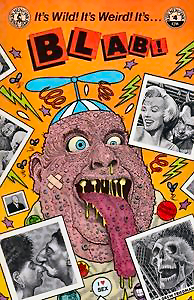
BLAB
#4

Everything
You Ever Wanted to Know About the GARBAGE PAIL KIDS, But Were Afraid to Ask.

A Conversation with GARBAGE PAIL KIDS Creator Mark Newgarden.

Summer
1989

By
Monte Beauchamp

I believe
it was Carl Sandburg who mused rhetorically, “Why oh why did the children
put beans in their ears, when the
one thing we told them not to
do was put beans in their ears?”

Anyway – while you ponder that
major profundity, allow us to explain that the indepth interview you’re about
to savor is definitely not about beans. Instead, it examines that eternal joy
all children experience when they do something (hell,
anything) that bothers
adults very much. C’mon… weren’t you always secretly in love with grotesque
gags like plastic up-chuck and rubber boogers?

Don’t be afraid to ‘fess
up! There’s something magic about sickeningly sophomoric vulgar humor, and when
it manages to offend everyone from Ann Landers to the Archdiocese, it begins to
approach majesty! Add the ability to blend the cheapest kind of Johnson Smith
“Liar’s License” novelty with Kurtzmaniac humor of a surprisingly high
caliber and what you’ve got is some top-flight frosting on a very special cheesecake.

Of
course, what we’re referring to are
Garbage
Pail Kids
stickers from the Topps Chewing Gum
Co. -one of the hottest preteen fads of this, or any decade. And the interview
with
Garbage Pail Kids
creator Mark Newgarden that follows is the brand of eclectic irrelevancy you’ll
only find in the warped (but acid-free) pages of
Blab!.

Read on and discover how Topps and Newgarden are revitalizing the satire
market just in time for another baby boom.

*
* *

How Did the
concept to do a gum card series based on such perverse characters as the Garbage
Pail Kids originate?

Basically it evolved out of a revival of a series
of gum card stickers called Wacky Packages. The original series was conceived
by Art Spiegelman in the late Sixties, and I collected them as a kid. They were
Mad-style parodies of almost every consumer product imaginable, from food
to floorwax, and had a long run for a Topps novelty – deep in the Seventies. Then,
in 1984, Topps decided it was time to try them out again, and I wound up doing
most of the gags. One of these concepts was a parody of the super-hot Cabbage
Patch Kids
dolls called Garbage Pail Kids. So that was the seminal
idea for the whole thing. However, that particular entry never made it into the
upcoming 1985 Wacky Packs series. At a meeting which I wasn’t present at,
the idea to parody the Cabbage Patch Kids was under consideration and this
Garbage Pail Kid painting that had been done for Wacky Packs was
brought up. And it was decided to spin it off into a full-blown parody series
of its own. So that’s how the whole mess got started.

So you were
involved in the creation of the Garbage Pail Kids right from the start?


Yeah. The actual term, the Garbage Pail Kids was mine, and the first prototype,
which was this Wacky Packs sticker, was also mine.


Final Artwork by John Pound

Did
you have any idea that the first set would be such a success with the kids, yet
at the same time outrage a lot of parents?

I guess I thought it should
be somewhat successful, because there hadn’t been anything quite like it in kid
culture in a long time. It was something that I would have loved when I was a
kid.
As for outraging parents, it didn’t specifically occur to me at the time;
in retrospect it seems like an integral part of the concept. I remember thinking
that when some of the finished art started coming in that it was really nice and
that it might get a glance of recognition beyond that of your typical kid purchaser,
but I didn’t feel there was very much in that first series that would truly outrage
anybody.
I really enjoyed working on the first series… it was something
new and by far the most creative project that I had worked on for Topps up to
that time. As I recall, I was the only one at Topps who was at all enthusiastic
about the project. Nobody else involved seemed to be too enthusiastic about the
series at this point; it was just something we were mandated to do.

Wasn’t
the series, commercially, sort of a dud to begin with?

Well, from what
I was told, early testing of the series wasn’t very successful. Topps had tested
it in a few markets and it didn’t do well except for one test market, which I
believe was somewhere in Pennsylvania, where it did very, very well, and it gave
Topps the idea that the series just might have potential. Then, amongst the kids,
the word started getting out about the series. The whole gum card phenomenon is
almost an underground type of thing. It’s something a kid can buy with his own
money, a real personal kind of purchase that doesn’t involve the kid’s parents’
or teacher’s approval. It’s something that is strictly on the kid’s own level.
And that’s how it started to build momentum: kids found the product, got a kick
out of it, told their friends about it and started to collect the things.

But the Garbage Pail Kids became much more than just another gum
card series, they became a fad. What was it that caused the series to really catch
on?

I think it was all the negative publicity that really got the ball
rolling. Bob Greene, a very widely syndicated newspaper columnist, wrote a really
scathing piece about how harmful and awful these bubble gum stickers were, which
in turn started a whole barrage of similar articles. It made the wire services,
magazines and TV news fillers, and when parents started telling their kids “I
forbid you to have these awful, destructive things,” teh more popular the
series became.

The series really outraged grade school teachers. What
was thir main complaint?

That the kids brought their stacks of cards into
the classroom. Of course, Garbage Pail Kids are a functional utilitarian
product, not merely a passive entertainment. Each card carries an offensive name
as well as a disgusting image. Subsequently, for instance, I guess a lot of 10-year-old
Kellys of America wound up with a Smelly Kelly Garbage Pail Kid sticker
on their desk, chair, or head. Also, the backs of the cards featured licenses
and awards designed for the user to taunt his selected victim with. Topps has
been producing similar cards for years.
Another complaint was that the kids
would bring them to school and trade them during class.

Did any of
the TV evangelists protest the series?

Probably all of them did. I know
the series made the front cover of Falwell’s magazine at one point, which was
one of the proudest moments of my life. [Laughter.]

Did Topps receive
any hate mail concerning the series? Any bomb threats, stuff like that?


Unfortunately it’s one of the company’s policies not to let anyone in the creative
department see much of the mail, but I know that we were getting tons of hate
mail, and what I saw was really sick, vicious stuff. I remember a top executive
telling us that the first letter he opened one morning accused him of being the
devil!

Who’s the artist that paints the fronts of the cards?

That’s John Pound, who did all of the fronts for the first two series on his own.
With the third series we brought in Tom Bunk, who has become just as important
a contributor.

How’d you come to select Pound as the main artist for
the series?

Well, Pound had worked on that Wacky Packs series that
the concept for the first Garbage Pail Kid card had originated from. Plus
he had done some nice work for various underground comix and paperback covers.
He’s a good cartoonist who can paint real well, and that’s what was needed for
the series. Before we had any idea where we actually wanted to go with the series,
we assigned the concept out loosely to a few artists and told them to let their
imaginations run wild. And of the three artists we tried out, Pound scored the
real bullseye.

Who were the other two artists that you auditioned
for the series?

One was Robert Grossman, the famous airbrush illustrator
who’s been around since the Sixties and has done everything in the way
of illustration. Grossman had done some Wacky Packs for us earlier, primarily
because his own kids were really into them. The other artist that was tried out
was Howard Cruse, and his submissions were like these twisted doll creatures and
weren’t at all what we had in mind.

Since Pound was kept busy doing
the fronts for the first two series, who did you get to draw the backs?


The backs of the first two series were drawn by Tom Bunk, who, as I mentioned
earlier, started helping out doing the fronts beginning with the third series.

Why isn’t the artwork signed by the artist?
A good question. It’s
another one of Topps’ plicies, one that they’ve adhered to for a long, long time.
Personally, I feel that it’s wrong.

Who are some of the writers that
come up with the gags for the backs of the cards?

Actually the backs
for the first two series were sort of adapted from some of Topps’ older series.
So except for what was adapted, I probably wrote the first six series. Other writers
have included John Mariano, a stand-up comic and actor who’s also a cartoonist,
and underground comix artist Jay Lynch has contributed much of the writing and
artwork for the backs. Also, the “Flick It” protionon the backs of the
last several series, which emulates a flipbook-type effect, were animated by Richard
McGuire.

Just how successful was the seriesin relation to other non-sport
card series that Topps has released in the past?

In terms of non-sport
cards, the Garbage Pail Kids are probably our most successful series. I
think that out of the 16 series we’ve done so far, it wsa the third series that
sold the most.

Had Topps ever released a series prior to the Garbage
Pail Kids
that caused a similar public outcry?

I can’t think of any
series that has caused a similar outcry to the extent that Garbage Pail Kids has.
Of course, back in 1963 the Mars Attacks cards caused quite a public uproar, but
at that time Topps was pretty sheepish about any negative publicity and curtailed
the distribution of that series themselves, before it really got out of hand.

Didn’t the makers of the Cabbage Patch Kids hassle Topps about
the series? What was that all about?

Well, to be quite frank, I believe
they saw how well the series was doing so they decided to come after Topps. I
can’t really go into much detail about it, but there was a court case, which tied
our hands from working on the series for a little while. But eventually the whole
thing was settled out of court.

Was the settlement favorable to Topps?
We’re still producing the series, so I’d say it was favorable?

There was
a certain sum of money that Topps had to pay, which I’m not at liberty to disclose.

With the 10th series there was a change in the design of the characters.
Was this a result of the settlement?

Yeah. Part of the requirement in
the settlement demanded minor changes in the actual characters and teh cards design.
A blatant example would be the logo across the top of the cards. It was originallyin
a curved, cloud-like design and now it’s in a straight banner. The look of the
characters changed too, but a lot of people haven’t particularly noticed it. The
shape of the characters’ heads changed substantially, the shape of their eyeballs
and the proportion of their bodies was altered. We are no longer able to depict
the characters as soft sculptured dolls; they’re now rendered as hard plastic.

I read where the design for the Cabbage Patch Kids was lifted from
an uncopyrighted source. Is there any truth to this?

I heard the same
exact rumor also, but I have no way of knowing whether it’s true or not.

Wasn’t Topps at one point planning to release a comic book about the Garbage
Pail Kids
?

Topps never was, but they were actually working on a deal
with DC Comics to do one. It was terminated rather quickly, though. DC backed
out as soon as the lawsuit controversy got under way.

How about the
Saturday morning Garbage Pail Kids cartoon series? Why was that project
shelved?

CBS was well into production with it, it was listed in TV
Guide
and there were newspaper listings all aroudn the country for it, but
then at the last moment it was dumped because of continuous pressure from various
parents’ groups, particularly one TV watchdog group called The American Family
Association. Donald Wildmon is the head of this organization and he’s the same
“genius” who instigated the recent problems for Ralph Bakshi’s new Mighty
Mouse
cartoon series by claiming in one episode Mighty Mouse was sniffing
cocaine. [Laughter.]

It sounds as though he’s some sort of far-right
religious fanatic.

I don’t know if he’s a religious fanatic, but I do
know that he’s powerful. The Garbage Pail Kids never made it to Saturday
morning TV and the alleged cocaine sniffing scene in Mighty Mouse got excised
because of him.
Actually I’m delighted the TV series was canned. I’ve seen
the pilot episode and it’s lame, castrated version of the Garbage Pail Kids,
carefully avoiding everything that made our cards work. It’s just as well that
it never made it to television. [Laughter.]

How’d the Garbage Pail
Kids
movie do at the theatres?

The movie did terrible. I heard it
actually lost money. [Laughter.] And deservedly so… it’s probably one of the
worst films I have seen in my entire life.

Yeah, it really sucked.
Were you at all involved with the production of it?

No, not at all. I
had absolutely no connection with the production of that movie. It’s so bad that
in maybe 15 or 20 years it just might become a cult classic.

Sort
of like, “it’s so bad, it’s good”?

It brought new meaning to
the word bad. I was sick and depressed about the whole thing.

Did
the Garbage Pail Kids fad just take place here in America, or was it a
worldwide phenomenon?

Actually, the Garbage Pail Kids did make
it to other countries. They were marketed in England, Ireland, Mexico, Japan,
France, Germany, Israel and probably a few other countries.

Were the
parents from these other countries as outraged over the series as those parents
here?

Oh yeah! I’ve got some articles from Mexico mentioning how horribly
outraged the Mexicans were over the series. Wherever teh Garbage Pail Kids
appear, the reaction by the parents of the world is pretty much the same.

Did you ever have any other alternative names for the series?

No, it was always called the Garbage Pail Kids. When Topps began getting
hassled by the makers of Cabbage Patch Kids, the name The Garbage Gang
came into play on the backs of the cards, solely as a backup name just in case
we ever legally have to change the name of the series. But from the beginning
it was always the Garbage Pail Kids. The name came before anything else,
really.

Were there ever any stickers in particular that met with such
parental outrage that Topps pulled them from the series, or were forced to tone
them down?

No cards were ever actually pulled from any of the series,
but various ones have been complained about by special interest groups. In the
first series there was an alcoholic Garbage Pail Kid with the DTs [Laughter.]…
and Mothers Against Drunk Driving had a lot of problems with that one; also a
Hell’s Angels Garbage Pail Kid guzzling beer didn’t meet with their approval
either (2nd series).
We did have to change the names on a few cards when we
went back to press, for example: Cindy Lopper (changed in Australia), Mad Donna
(not changed) and Woody Alan because they parodied famous people’s names. Also
a few of the cards that parodied trademarks we had to alter.

Did any
of the gum card distributors threaten to boycott the series?

Well, I
know that Southland 7-11 banned them, but they’re a retailer, not a distributor.
They’re also the same outfit that stopped carrying Playboy adn Penthouse
when Attorney General Edwin Meese illegally sent out letters to wholesalers and
retailers insinuating that anyone distributing such adult material could wind
up in big trouble.

Have
you submitted any cards that shocked ethe executives at Topps? Any that they’ve
refused to release?

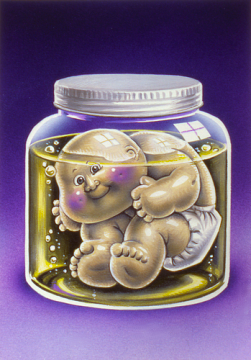
Yeah, we’ve done some, but we keep resubmitting them
until we wear them down. So most of those submissions have found their way into
the series in one form or another. But there was one that we never got anywhere
with, that they flat out said no to, and that was one that showed a fetus in a
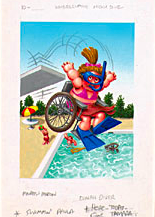
mason jar. That one just didn’t get too far. I recall another one with a little
girl in a wheel chair diving off of a diving board that was never printed either.


Unpublished Artwork by John Pound —
Later Poublished in Flashback Set


Unpublished Artwork by John Pound

Have
you come up with any card concepts for the series so disgusting that you’ve censored
them yourself?

Well, I remember one that Art Spiegelman came up with that
I felt was totally unacceptable. It was an image of a Garbage Pail Kid
sliding down a bannister that’s actually a gigantic razor blade. So we compromised
on that concept and made it a wooden bannister with lots of knives sticking out
of it instead. [Laughter.] (11th Series 453a “Dead End KIT” and 453b
“Slidin’ CLYDE”)

So
you guys do have a set of standards.

Yeah, amazing at it seems. There
are certain areas that we don’t dare delve into. Some of the best Garbage Pail
Kids
images were based on classic, iconic images like Uncle Sam and the Statue
of Liberty, so obviously a crucified Jesus Garbage Pail Kid would be a
perfect image to produce. But there’s no way Topps would go for it. Religion is
a taboo.

The main theme of the series revolved around almost every
imaginable bodily excretion. It’s a theme that has made millions of dollars for
Topps. Why are kids so fascinated with this subject?

Well, kids are both
fascinated and repelled by their bodies before and during adolescence. It’s an
area of development that can cause them great anxiety. One way for kids to release
this anxiety is through humor, and I believe that’s where a lot of the success
of the Garbage Pail Kids comes from.

During the mid-Fifties
a comics code was instigated to keep crime and horror comics off the newsstands.
Does Topps fear that someday someone may try to instigate a similar code against
the gum card industry?

The Comics Code was created by certain people within
the comic book industry, whereas Topps is the gum card industry. So there’s
not a lot of competition going on, except, of course, with some of the other companies
doing their versions of baseball cards. So I can’t really foresee any kind of
outside regulatory authority coming along and affecting us.

The series
really rattled a lot of parents’ cages. Do your parents approve of your involvement
in the series?

Yeah, as a matter-of-fact, they are damn proud. [Laughter.]
They’ve seen me producing a similar sort of thing ever since I was six years old,
so I think they’re pretty happy I found a slot somewhere to express the more pervers
aspect of my personality.

How do children act around you when they
find out you’re the creator of the series? Do they treat you like a Beatle?


Oh god no! But I remember back during the summer of 1986 during the Statue of
Liberty centennial, a friend and I were hanging out in Libert Park and the crowds
were just enormous, and it got to the point where we just couldn’t move. For hours
we wound up standing next to this family from the Midwest, and at some point,
my friend mentioned to their young son that I was the creator of the Garbage
Pail Kids
, and the kid was just amazed; he couldn’t believe it. So I stood
around and drew him some characters and answered every imaginable question about
the Garbage Pail Kids. His parents weren’t very happy about it though.
They seem pretty annoyed. [Laughter.]

Have any Garbage Pail Kids
groupies ever chased you down the street?

I haven’t encountered any Garbage
Pail Kid
groupies yet – luckily!!!

Do you find working on the
series to still be appealing?

Early on it was a lot of fun, but now I
feel that creatively it’s kind of run its course. We’re just doing variations
upon variations at this point.
The most interesting work I have at Topps right
now is developing a new series in collaboration with Drew Friedman that will make
the Garbage Pail Kids seem like Care Bears.

How about
going through the process on how an actual Garbage Pail Kid card is produced?


Well, the ideas can come at any time and in any form. When the series was at the
height of its mania, Art Spiegelman and I were literally dreaming them up. Quite
a few of the ideas came from dreams.

Would
these be drug-induced dreams?

[Laughter.] Overworked-induced dreams more
than anything else. Basically our minds were just so geared to finding one more
idea for these things that at first it became a game, and then an obsession. So
I guess it just kind of spilled over into our dreams.
But getting back to
the process, Art and I sit around the table coming up with ideas, and either give
them a thumb’s up or a thumb’s down. Then – at least with the first couple of
series – I would do pencil roughs for the artist to follow, but I haven’t done
that for a long time. For Tom Bunk we’ll make the simplest doodles; for John Pound,
who lives in California, they’re just described over the phone. Then, the next
stage is for the artist to do very tight pencils, and it is at this stage where
we’ll make suggestions or corrections.
After all the paintings for a series
are completed, we’ll have these massive naming sessions.
At this point in
the game we’ve done over 600 characters, and since we name each character twice,
once for the A series and once for the B series, that’s over 1200 names
we’ve had to come up with.

Is there a particular size the finished
art for the cards is done at?

The finished paintings are done at five
by seven inches.

What medium are they done in?
A variety.
John Pound does his in a combination of acrylic and airbrush, and Tom Bunk does
his in gouache… which reminds me, there was a third artist who started helping
out around the fourth or fifth series, and that was James Warhola – Andy Warhol’s
nephew. He’s been doing a lot of children’s book illustrations, which is why he
hasn’t been able to do any cards for us lately, but when he did he would render
his in oils. So that’s three different techniques doing the bulk of these things.

There’ve been a few other artists who have done some of the fronts here and there,
but the vast majority of them have been by Bunk and Pound, and Warhola made a
big contribution to the series, too.

Did the success of the series
spawn any imitations?

Yeah. There were some put out by really small companies.
There was a series called Trash Can Tots, one called Trash Can Kids
and another one called Bunch O’Brats. But aesthetically they were truly
awful. They look as if they were drawn by company accountants.

Why
do you think so many parents were outraged over the Garbage Pail Kids?


It’s impossible to generalize, but I think a lot of adults are really out of touch
with the child in themselves. They forget what it’s like to be a kid.
Then
there are certain people who scan the culture looking for things to be outraged
about – self-appointed censors and moralists. Mighty Mouse will come along
and the next thing you know it’s Mighty Mouse snorting cocaine, or it could
be anything else.

That brings me to mind Ann Landers. I’m sure she
really got bent out of shape over the series.

Yeah. Ann Landers truly
hates the Garbage Pail Kids. She’s been pretty vicious about them. “Dear
Abby” as well. But keep in mind that others have been understanding about
the cards. Psychologists have successfully used them in therapy with children.
I’ve heard of a case where a Garbage Pail Kid card was the first thing
an autistic child ever responded to in his life. But these are the stories that
don’t get much press.

Is the bubble gum card business one that you’d
encourage young artists to try and break into?

The whole idea of a bubble
gum card business is pretty ridiculous, really. It’s not exactly something I would
direct young artists towards. They sure aren’t going to find a pot of gold waiting
for them in the bubble gum card industry. [Laughter.]
With the success of
the Garbage Pail Kids it’s really hard to say where it will all lead. It’s
certainly enabled Topps to try some things that it normally wouldn’t do, like
our recent Dinosaurs Attack, and an upcoming series with Drew Friedman.
But where Topps’ business is really at is with baseball cards – that has reached
monstrous proportions. These other series are just a subsidiary sort of thing.
Every so often it’ll pay off and they’ll have a monster hit with something like
the Garbage Pail Kids.

How’d you get involved in the bubble
gum card business?

Through Art Spiegelman, who’s been with Topps for over
20 years now. I was a student at the School of Visual Arts in New York City and
took a class of his – along with Drew Friedman and Kaz – called Language of the
Comics during 1979. After the course was over all three of us got a call from
Art asking us to be in this magazine he was doing, which turned out to be the
first issue of Raw. Then after I graduated, Art asked me to come to Topps
to work on a few projects, and I’ve been working there as a consultant ever since.

Were you a bubble gum card fanatic as a kid?
Maybe not a fanatic,
but I was an avid consumer. I remember being crazy about those Batman cards
painted by veteran pulp magazine artist Norm Saunders. I also collected The
Monkees
gum cards… a lot of the monster cards; Wacky Packages; and
also Ugly Stickers, which I got into at the tail end of the series. And
even baseball cards for a while, though I had absolutely no interest in baseball.

What
other cultural trash did you enjoy as a kid? As creator of the Garbage Pail
Kids
, something must have really warped your mind.

Oh yeah – I was
definitely warped by the usual graphic trash Americana available to a child growing
up in the Sixties. First, old cartoons on TV, then comic books, Mad magazine
– especially Harvey Kurtzman’s version of Mad reprinted in paperback form
– Famous Monsters of Filmland, Creepy, Eerie, National
Lampoon
and underground comix.

Is there anything else you’re involved
with that you’d like the readers to know about before we sign off?

Currently
I’m producing a weekly syndicated strip that appears in the New York Press
and in various alternative papers in Baltimore, Washington, D.C. and San Diego.
I’m a regular contributor to Raw and I’m co-editing Bad News with
Paul Karasik, now in its third big issue. I also do freelance illustration, I
teach, and there’s various other projects I’m involved in, too vague to mention.


CABBAGE
PATCH DOLLS GET DUMPED
FOR A HOT NEW COLLECTOR’S ITEM:
IT’S
THE GARBAGE PAIL KIDS
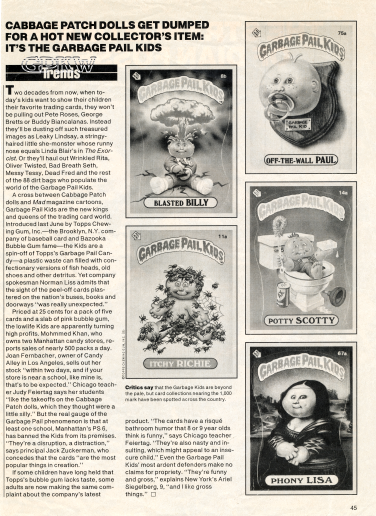

PEOPLE MAGAZINE

Critics
say that the Garbage Kids are beyond the pale, but card collections nearing the
1,000 mark have been spotted across the country.

Trends:
February 17, 1986

Two
decades from now, when today’s kids want to show their children their favorite
trading cards, they won’t be pulling out Pete Roses, George Bretts, or Buddy
Blancalanas. Instead they’ll be dusting off such treasured images as Leaky
Lindsay, a stringy-haired little she-monster whose runny nose equals Linda Blair’s
in The Exorcist. Or they’ll haul out Wrinkled Rita, Oliver Twisted,
Bad Breath Seth, Messy Tessy, Dead Fred and the rest of the 88 dirt bags who populate
the world of the Garbage Pail Kids.

A
cross between Cabbage Patch dolls and Mad magazine cartoons, Garbage Pail
Kids are the new kings and queens of the trading card world. Introduced last June
by Topps Chewing Gum, Inc.–the Brooklyn N.Y. company of baseball card and Bazooka
Bubble Gum fame–the Kids are a spin-off of Topp’s Garbage Pail Candy- a
plastic waste can filled with confectionary versions of fish heads, old shoes
and other detritus. Yet company spokesman Norman Liss admits that the sight of
the peel-off cards plastered on the nation’s buses, books and doorways “was
really unexpected.”   

Priced
at 25 cents for a pack of five cards and a slab of pink bubble gum, the lowlife
Kids are apparently turning high profits. Mohmmed Khan, who owns two Manhattan
candy stores, reports sales of nearly 500 packs a day. Joan Fernbacher, owner
of Candy Alley in Los Angeles, sells out her stock “within two days, and
if your store is near a school, like mine is, that’s to be expected.”
Chicago teacher Judy Feiertag says her students “like the takeoffs on the
Cabbage Patch dolls, which they thought were a little silly.” But the real
gauge of the Garbage Pail phenomenon is that at least one school, Manhattan’s
PS 6, has banned the Kids from its premises.

“They’re
a disruption, a distraction,” says principal Jack Zucherman, who concedes
that the cards “are the most popular things in creation.” 

If
some children have long held that Topps’s bubble gum lacks taste, some adults
are now making the same complaint about the company’s latest product. “The
cards have a risque bathroom humor that 8 or 9 year olds think is funny,”
says Chicago teacher Feiertag. “They’re also nasty and insulting, which
might appeal to an insecure child.” Even the Garbage Pail Kids’ most
ardent defenders make no claims for propriety. “They’re funny and gross,”
explains New York’s Ariel Siegelberg, 9,” and I like gross things.”

*

THIS
FAD IS STRAIGHT FROM
THE GARBAGE CAN
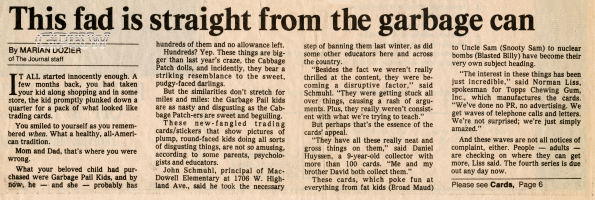
By
Marian Dozier
of The Journal staff

The
Milwaukee Journal

Sunday,
June 22, 1986

It all started
innocently enough. A few months back, you had taken your kid along shopping and
in some store, the kid promptly plunked down a quarter for a pack of what looked
like trading cards.

You smiled to yourself as you remembered when.
What a healthy, all-American tradition.  

Mom
and Dad, that’s where you were wrong.

What
your beloved child had purchased were Garbage Pail Kids, and by now, he –
and she – probably has hundreds of them and no allowance left.    

Hundreds?
Yep. These things are bigger than last year’s craze, the Cabbage Patch dolls,
and incidently, they bear a striking resemblance to the sweet, pudgy-faced darlings.

But
the similarities don’t stretch for miles and miles: the Garbage Pail kids
are as nasty and disgusting as the Cabbage Patch-ers are sweet and beguiling.

These
new-fangled trading cards/stickers that show pictures of plump, round-faced kids
doing all sorts of disgusting things, are not so amusing, according to some parents,
psychologists and educators.

John
Schmuhl, principal of MacDowell Elementary at 1706 W. Highland Ave., said he took
the necessary step of banning them last winter, as did some educators here and
across the country.

“Besides
the fact we weren’t really thrilled at the content, they were becoming a
disruptive factor,” said Schmuhl. “They were getting stuck all over
things, causing a rash of arguments. Plus, they really weren’t consistent
with what we’re trying to teach.”

But
perhaps that’s the essence of the cards’ appeal.

“They
have all these really neat and gross things on them,” said Daniel Huyssen,
a 9-year-old collector with more than 100 cards. “Me and my brother David
both collect them.”

These
cards, which poke fun at everything from fat kids (Broad Maud) to Uncle Sam (Snooty
Sam) to nuclear bombs (Blasted Billy) have become their very own subject heading.

“The
interest in these things has been just incredible,” said Norman Liss, spokesman
for Topps Chewing Gum, Inc., which manufactures the cards. “We’ve done
no PR, no advertising. We get waves of telephone calls and letters. We’re
not surprised; we’re just simply amazed.”

And
these waves are not all notices of complaint, either. People – adults –
are checking on where they can get more, Liss said. The fourth series is due out
any day now.

——

Please
see Cards, Page 6

JUST
ANOTHER FAD, ANOTHER PHASE
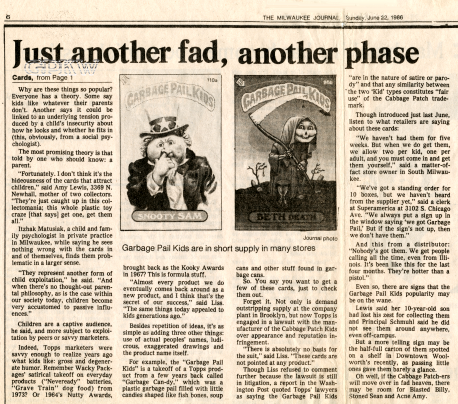
Garbage
Pail Kids are in short supply in many stores

Cards,
from Page 1

——

Why
are these things so popular? Everyone has a theory. Some say kids like whatever
their parents don’t. Another says it could be linked to an underlying tension
produced by a child’s insecurity about how he looks and whether he fits in
(this, obviously, from a social psychologist).

The
most promising theory is that told by one who should know: a parent.

“Fortunately,
I don’t think it’s the hideousness of the cards that attract children,”
said Amy Lewis, 3369 N. Newhall, mother of two collectors. “They’re
just caught up in this collectomania: this whole plastic toy craze (that says)
get one, get them all.”

Itzhak
Matusiak, a child and family psychologist in private practice in Milwaukee, while
saying he sees nothing wrong with the cards in and of themselves, finds them problematic
in a larger sense.

“They represent
another form of child exploitation,” he said. “And when there’s
no thought-out parental philosophy, as is the case within our society today, children
become very accustomed to passive influences.”
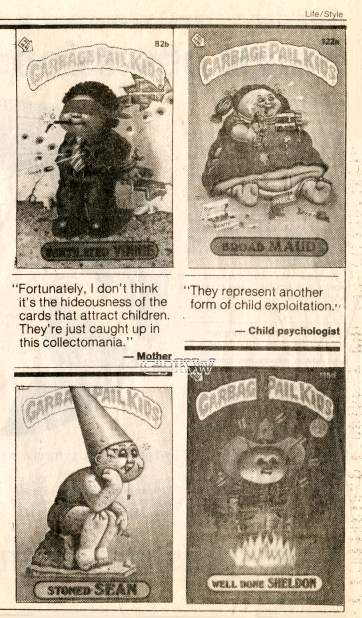
Children
are a captive audience, he said, and more subject to exploitation by peers or
savvy marketers.

Indeed, Topps
marketers were savvy enough to realize years ago what kids like: gross and degenerate
humor. Remember Wacky Packages’ satirical takeoff on everyday products (“Neveready”
batteries, “Grave Train” dog food) from 1973? Or 1964’s Nutty Awards,
brought back as the Kooky Awards in 1967? This is formula stuff.

“Almost
every product we do eventually comes back around as a new product, and I think
that’s the secret of our success,” said Liss. “The same things
today appealed to kids generations ago.”

Besides
repetition of ideas, it’s as simple as adding three other things: use of
actual peoples’ names, ludicrous, exaggerated drawings and the product name
itself.

For example, the “Garbage
Pail Kids” is a takeoff of a Topps product from a few years back called “Garbage
Can-dy,” which was a plastic garbage pail filled with little candies shaped
like fish bones, soup cans and other stuff found in garbage cans.

So.
You say you want to get a few of these cards, just to check them out.

Forget
it. Not only is demand outstripping supply at the company plant in Brooklyn, but
now Topps is engaged in a lawsuit with the manufacturer of the Cabbage Patch Kids
over appearance and reputation infringement.

“There
is absolutely no basis for the suit,” said Liss. “These cards are not
pointed at any product.”

Though
Liss refused to comment further because the lawsuit is still in litigation, a
report in the Washington Post quoted Topps’ lawyers as saying the Garbage
Pail Kids “are in the nature of satire or parody” and that any similarity
between the two ‘Kid” types constitutes “fair use” of the
Cabbage Patch trademark.

Though
introduced just last June, listen to what retailers are saying about these cards:

“We
haven’t had them for five weeks. But when we do get them, we allow two per
kid, one per adult, and you must come in and get them yourself,” said a matter-of-fact
store owner in South Milwaukee.

“We’ve
got a standing order for 10 boxes, but we haven’t heard from the supplier
yet,” said a clerk at Superamerica at 3102 S. Chicago Ave. “We always
put a sign up in the window saying ‘we got Garbage Pail,’ But if the
sign’s not up, then we don’t have them.”

And
this from a distributor: “Nobody’s got them. We get people calling all
the time, even from Illinois. It’s been like this for the last four months.
They’re hotter than a pistol.”

Even
so, there are signs that the Garbage Pail Kids popularity may be on the wane.

Lewis
said her 10-year-old son had lost his zest for collecting them and Principal Schmuhl
said he did not see them around anywhere, even off-campus.

But
a more telling sign may be the half-full carton of them spotted on a shelf in
Downtown Woolworth’s recently, as passing little ones gave them barely a
glance.

Oh well, if the Cabbage
Patch-ers will move over in fad heaven, there may be room for Blasted Billy, Stoned
Sean and Acne Amy.

*

GARBAGE
PAIL GANG DRAGGED INTO COURT
CABBAGE
KIDS Act Like Brats

By
Joseph B. Frazier
of The Associated Press

THE
DAILY NEWS

June 24, 1986

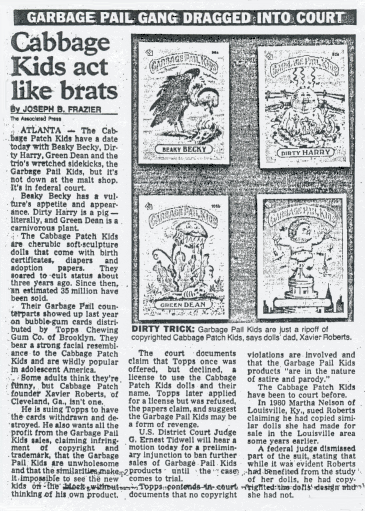
DIRTY TRICK: Garbage Pail Kids are just a ripoff of copyrighted Cabbage Patch
Kids, says dolls’ dad, Xavier Roberts.

Atlanta
– The Cabbage Patch Kids have a date today with “Beaky BECKY”, “Dirty
HARRY”, “Green DEAN” and the trio’s wretched sidekicks, the Garbage
Pail Kids, but it’s not down at the malt shop. It’s in federal court.

“Beaky BECKY” has a vulture’s appetite and appearance. “Dirty HARRY”
is a pig – literally, and “Green DEAN” is a carnivour plant.

The Cabbage Patch Kids are cherubic soft-sculpture dolls that come with birth
certificates, diapers, and adoption papers. They soared to cult status about three
years ago. Since then, an estimated 35 million have been sold.

Their
Garbage Pail counterparts showed up last year on bubble-gum cards distributed
by Topps Chewing Gum Co. of Brooklyn. They bear a strong facial resemblence to
the Cabbage Patch Kids and are wildly popular in adolescent America.

Some adults thing they’re funny, but Cabbage Patch founder Xavier Roberts, of
Cleveland, GA., isn’t one.

He is
suing Topps to have the cards withdrawn and destroyed. He also wants all the profit
from the Garbage Pail Kids sales, claiming infringement of copyright and trademark,
that the Garbage Pail Kids are unwholesome and that the similarities make it impossible
to see the new kids on the block, without thinking of his own product.

The court documents claim that Topps once was offered, but declined, a license
to use the Cabbage Patch Kids dolls and their name. Topps later applied for license
but was refused, the papers claim, and suggest the Garbage Pail Kids may be a
form of revenge.

The U.S. District Court Judge G. Ernest Tidwell will
hear a motion today for a preliminary injuction to ban further sales of Garbage
Pail Kids products until the case comes to trial.

Topps contends in court
documents that no copyright violations are involved and that the Garbage Pail
Kids products “are in the nature of satire and parody.”

The
Cabbage Patch Kids have been to court before.

In 1980 Martha Nelson of
Louisville, KY., sued Roberts claiming he had copied similar dolls she had made
for sale in the Louisville area some years earlier.

A federal judge dismissed
part of the suit, stating that while it was evident Roberts had benefited from
the study of her dolls, he had copyrighted the dolls design and she had not.

*

HAVE
YOU MET THE NEW ‘KIDS’?
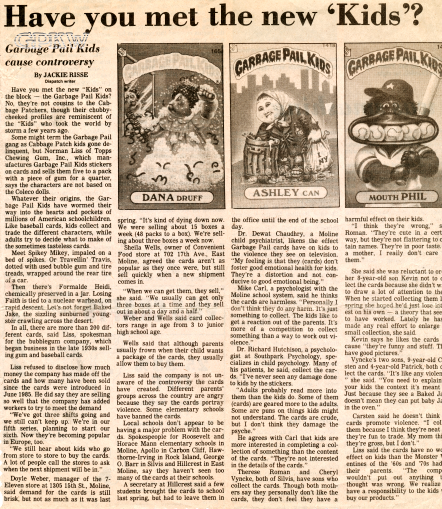
Garbage
Pail Kids cause controversy

By
Jackie Risse

The Daily Dispatch

Have
you met the new “Kids” on the block – the Garbage Pail Kids? No,
they’re not cousins to the Cabbage Patchers, though their chubby-cheeked
profiles are reminiscent of the “Kids” who took the world by storm a
few years ago.

Some might term
the Garbage Pail gang as Cabbage Patch kids gone delinquent, but Norman Liss of
Topps Chewing Gum, Inc., which manufactures Garbage Pail Kids stickers on cards
and sells them five to a pack with a piece of gum for a quarter, says the characters
are not based on the Coleco dolls.

Whatever
their origins, the Garbage Pail Kids have wormed their way into the hearts and
pockets of millions of American schoolchildren. Like baseball cards, kids collect
and trade the different characters, while adults try to decide what to make of
the sometimes tasteless cards.

Meet
Spikey Mikey, impaled on a bed of spikes. Or Travellin’ Travis dotted with
used bubble gum and tire treads, wrapped around the rear tire of a car.

Then
there’s Formalde Heidi, chemically preserved in a jar. Losing Faith is tied
to a nuclear warhead, on rapid decent. Let’s not forget Baked Jake, the sizzling
sunburned youngster crawling across the desert.

In
all, there are more than 200 different cards, said Liss, spokesman for the bubblegum
company, which began business in the late 1930’s selling gum and baseball
cards.

Liss refused to disclose
how much money the company has made off the cards and how many have been sold
since the cards were introduced in June 1985. He did say they are selling so well
that the company has added workers to try to meet the demand.

“We’ve
got three shifts going and we still can’t keep up. We’re in our fifth
series, planning to start our sixth. Now they’re becoming popular in Europe,
too.

“We still hear about
kids who go from store to store to buy the cards. A lot of people call the stores
to ask when the next shipment will be in.”

Doyle
Weber, manager of the 7-Eleven store at 1305 15th St., Moline, said
demand for the cards is still brisk, but not as much as it was last spring. “It’s
kind of dying down now. We were selling about 15 boxes a week (48 packs to a box).
We’re selling about three boxes a week now.”

Sheila
Wells, owner of Convenient Food store at 702 17th Ave., East Moline,
agreed the cards aren’t as popular as they once were, but still sell quickly
when a new shipment comes in.

“When
we can get them, they sell,” she said. “We usually can get only three
boxes at a time and they sell out in about a day and a half.”  Weber
and Wells said card collectors range in age from 3 to junior high school age.
Wells said that although parents usually frown when their child wants a package
of the cards, they usually allow them to buy them.

Liss
said the company is not unaware of the controversy the cards have created. Different
parents’ groups across the country are angry because they say the cards portray
violence. Some elementary schools have banned the cards.

Local
schools don’t appear to be having a major problem with the cards. Spokespeople
for Roosevelt and Horace Mann elementary schools in Moline, Apollo in Carbon Cliff,
Hawthorne-Irving in Rock Island, George O. Barr in Silvis and Hillcrest in East
Moline, say they haven’t seen too many of the cards at their schools.

A
secretary at Hillcrest said a few students brought the cards to school last spring,
but had to leave them in the office until the end of the school day.

Dr.
Dewat Chaudhry, a Moline child psychiatrist, likens the effect Garbage Pail cards
have on kids to the violence they see on television. “My feeling is that
they (cards) don’t foster good emotional health for kids. They’re a
distortion and not conducive to good emotional being.”

Mike
Carl, a psychologist with the Moline school system, said he thinks the cards are
harmless. “Personally I don’t think they do any harm. It’s just
something to collect. The kids like to get a reaction out of the parents. It’s
more of a competition to collect something than a way to work out violence.”

Dr.
Richard Hutchison, a psychologist at Southpark Psychology, specializes in child
psychology. Many of his patients, he said, collect the cards. “I’ve
never seen any damage done to kids by the stickers.

“Adults
probably read more into them than the kids do. Some of them (cards) are geared
more to the adults. Some are puns on things kids might not understand. The cards
are crude, but I don’t think they damage the psyche.”

He
agrees with Carl that kids are more interested in completing a collection of something
than the content of the cards. “They’re not interested in the details
of the cards.”

Therese Roman
and Cheryl Vyncke, both of Silvis, have sons who collect the cards. Though both
mothers say they personally don’t like the cards, they don’t feel they
have a harmful effect on their kids.

“I
think they’re wrong,” said Roman. “They’re cute in a certain
way, but they’re not flattering to certain names. They’re in poor taste.
As a mother, I really don’t care for them.”

She
said she was reluctant to order her 8-year-old son Kevin not to collect the cards
because she didn’t want to draw a lot of attention to them. When he started
collecting them last spring she hoped he’d just lose interest on his own
– a theory that seems to have worked. Lately he hasn’t made any real
effort to enlarge his small collection, she said.

Kevin
says he likes the cards because “they’re funny and stuff. They have
good pictures.”

Vyncke’s
two sons, 9-year-old Carsten and 4-year-old Patrick, both collect the cards. “It’s
like any violence, ” she said. “You need to explain to your kids the
context it’s meant in. Just because they see a Baked Jake doesn’t mean
they can put baby Jake in the oven.”

Carsten
said he doesn’t think the cards promote violence. “I collect them because
I think they’re neat and they’re fun to trade. My mom thinks they’re
gross, but I don’t.”

Liss
said the cards have no worse effect on kids than the Monster Valentines of the
‘60s and ‘70s had on their parents. “The company wouldn’t
put out anything they thought was wrong. We realize we have a responsibility to
the kids who buy our products.”

*

THE
RIVAL KIDS PATCH THINGS UP
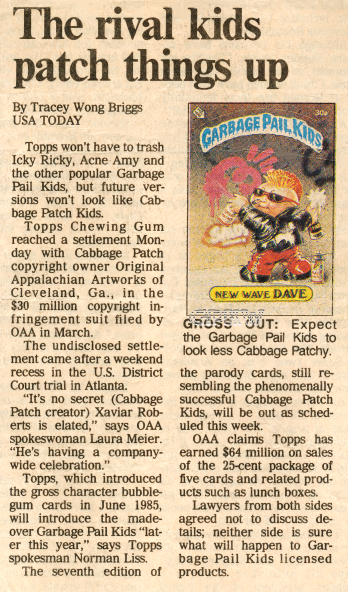
GROSS
OUT: Expect the Garbage Pail Kids to look less Cabbage Patchy.

By
Tracey Wong Briggs

USA
TODAY

Topps won’t
have to trash Icky Ricky, Acne Amy and the other popular Garbage Pail Kids, but
future versions won’t look like Cabbage Patch Kids.

Topps
Chewing Gum reached a settlement Monday with Cabbage Patch copyright owner Original
Appalachian Artworks of Cleveland, Ga., in the $30 million copyright infringement
suit filed by OAA in March. The undisclosed settlement came after a weekend recess
in the U.S. District Court trial in Atlanta.

“It’s
no secret (Cabbage Patch creator) Xaviar Roberts is elated,” says OAA spokeswoman
Laura Meier. “He’s having a company-wide celebration.”

Topps,
which introduced the gross character bubblegum cards in June 1985, will introduce
the made-over Garbage Pail Kids “later this year,” says Topps spokesman
Norman Liss.

The seventh edition
of the parody cards, still resembling the phenomenally successful Cabbage Patch
Kids, will be out as scheduled this week.

OAA
claims Topps has earned $64 million on sales of the 25-cent package of five cards
and related products such as lunch boxes.

Lawyers
from both sides agreed not to discuss details; neither side is sure what will
happen to Garbage Pail Kids licensed products.


Leave a Reply

Your email address will not be published. Required fields are marked *