CHEAP
TOYS ESSAY BY COLLECTOR RUSVAN
POSTED
WITH PERMISSION
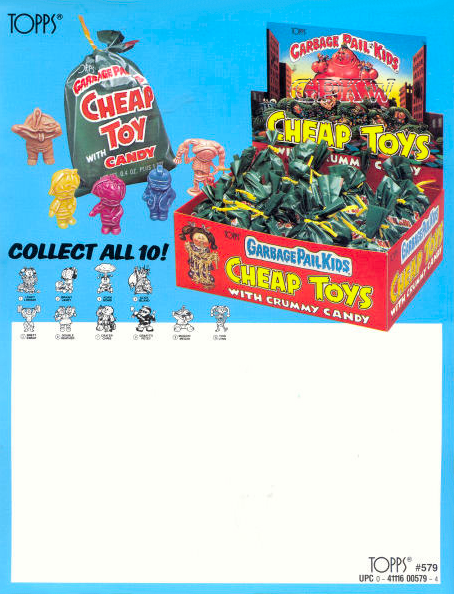
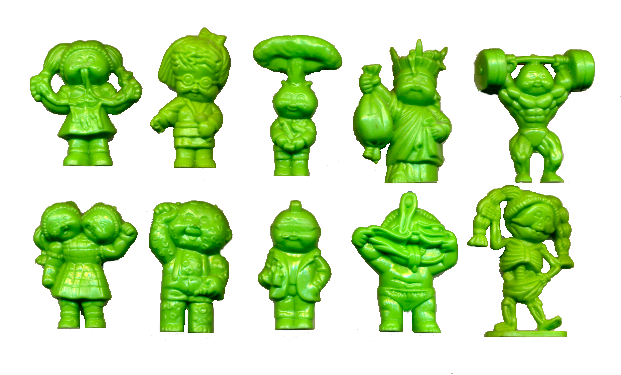
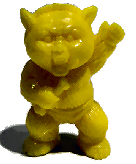
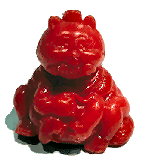
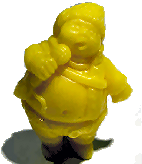
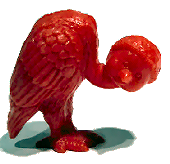
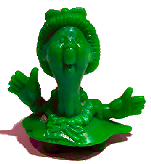
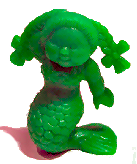
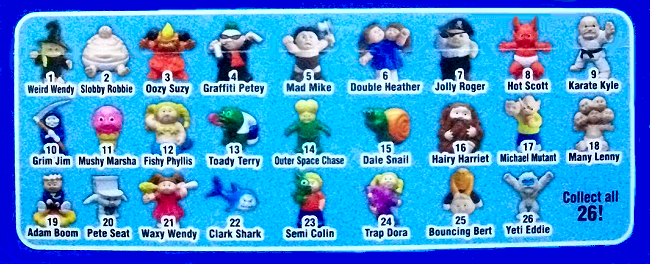
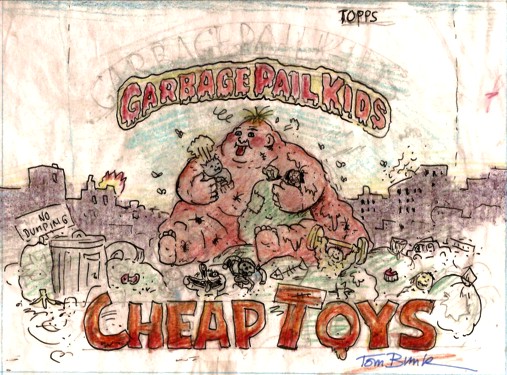
Cheap Toys are monochromatic mini figures based on Garbage
Pail Kids characters, and were produced by the Topps Chewing Gum Inc beginning
in 1986. Production for Cheap Toys began in the wake of Series 3 Garbage Pail
Kids, during the height of Garbage Pail Kids popularity. The Cheap Toy sculpts
are limited to characters from the first 3 series, with the majority of the figures
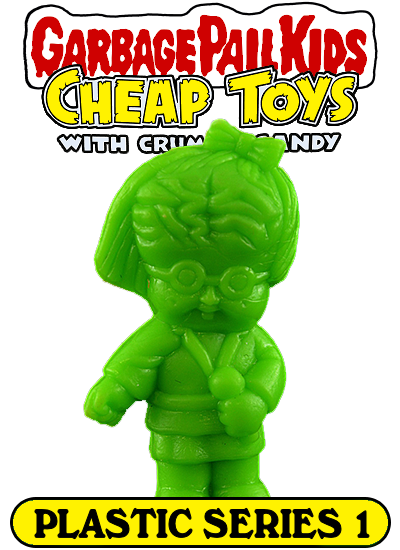
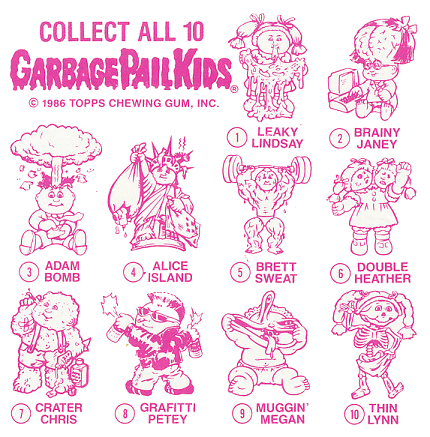
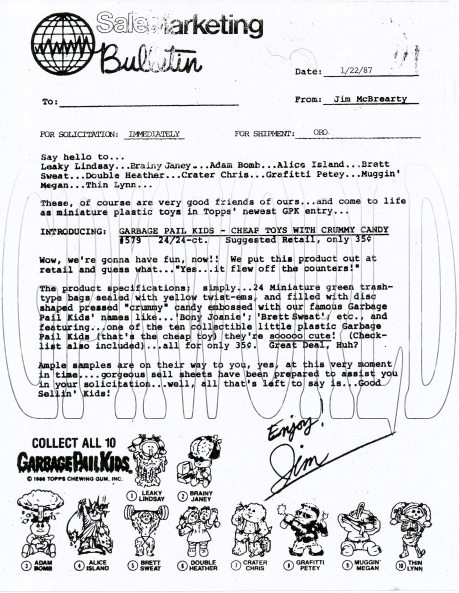
coming from the first two series. Leaky Lindsay, Double Heather, Brett Sweat,
Muggin’ Megan, Alice Island, Adam Bomb, Crater Chris, Graffiti Petey, Thin Lynn,
and Brainy Janey all made the first cut. Each sculpt is roughly the same height,
with Thin Lynn being the tallest, at around an inch and a half tall. The majority
of the sculpts follow the original character art, and demonstrate a high level
of technical skill through detail and rendering.
Cheap
Toys were originally created in Hong Kong at the Candy Novelty Inc. who had been
making candy and candy containers for Topps for decades. A team of designers,
lead by Jimmy Chan, created 10 sculpts for Series 1. It is unclear Jimmy Chan’s
role in the toys actual designs, and no other information exists for the other’s
involved. It could be even be revealed that Jimmy Chan is not an artist! Please
note that The Candy Novelty Inc. now goes under the name of Ausome and is still
prolific as always.
Series 1 sculpts
are the most popular of the two Cheap Toys series. This is due to many reasons,
but on an artistic level, the artist who created these was very successful. But
first, let’s discuss the cons. Most causal viewers comparing Series 1 Cheap
Toys with other mini figures will notice that they are small and basic, and lack
texture. Series 1 sculpts are also flat, and several of the sculpts do not ‘work’
from the side. That said, the Series 1 sculpts are for the most part contained
forms, with little protrusion, however several sculpts feature cut outs, also
referred to as trapped space or negative space. Furthermore, the Thin Lynn sculpt
features a basic platform used to support the balance of the figure. Without this
base, the sculpture could not stand on its own, and this feature is sometimes
frowned upon in the Art World. However, the use of bases in mini figures is the
norm in some toy lines.
The Series
1 sculpts do not fail as three-dimensional designs. Where the artist sometimes
seemed to ignore the element of texture, it was replaced by exquisite detailing.
For example, take a gaze at the glossy matrix of Brett Sweat’s muscles. Brett
Sweat is a mini figure masterpiece. This a fine example of how some Cheap Toys
improved upon a Garbage Pail Kid, in ways the original art failed.
What
the artist did capture, that other toy designers often miss, is the character’s
spirit and facial expression. How many times has this been a critique for sculptors:
the sculptor creates a sculpture of original composition and a mastery of form,
yet they forget to give their artwork a spirit???!!!!! So, for example, with all
the form problems of the too-economized Adam Bomb sculpt, the artist created,
perhaps, the finest GPK three-dimensional face of all time and, lucky for collectors,
he did it with GPK’s most iconic figure.
Also
take notice and ‘connect’ with the spirit of Thin Lynn that comes out
in her flirty, yet innocent body language that can be easily ‘translated’
by a glancing viewer. But the best example of this phenomenon of a sculpts character
‘saving’ its art-worthiness is in the sculpt of Graffiti Petey. In what
could have been a throw-away figure at first glace, the sculpt’s genius is
found by patient viewers in Petey’s tiny and transcendent eyes and smile.
How can an inch and a half define Generation X in spirit and form? Proof and explanation
can be given by many of the passionate collectors in this hobby who ‘found’
the beauty in these little sculptures.
An
important decision must have been made with great consideration, between the designers,
on the color of plastics that would be used in casting and whether the toys would
be hand-painted. A clever designer must have been on the team to have made the
decision to leave the toys unpainted. This choice could have been influenced by
the successful monochromatic MUSCLE toy line two years previous. Consider how
this toy line is in keeping with Punk Rock, the 1980’s, and DIY attitudes
and how that translated into the aesthetic of Cheap Toy’s design: monochromatic,
yet dynamic forms, with controversial content and an air of risk taking. One could
only look to Garbage Pail Kid’s original artists and the 80’s Zeitgeist
to understand how this toy line’s aesthetic was consciously and collaboratively
formed. In simple terms, Cheap Toys are an exemplar product of their times.
Series
1 was first manufactured for the American market and was first cast in 4 colors,
Blue, Red, Peach, and Green. Collectors further distinguish these 4 colors into
the 8 Base Colors: Light Red, Dark Red, Light Green, Lime Green, Dull Peach, Bubble
Gum Peach, Light Blue, and Dark Blue. A short time later ‘rubbery’ plastics
were introduced and these came in brighter colors. These were distributed in Cheap
Toy boxes in limited amounts. The new colors include Neon Red Orange and Yellow,
Salmon, Orange, and deep Blue-Green. Other color variants, such as Pea Green,
have been discovered. A number of these Cheap Toy colors come in a characteristic
glossiness that is unique to that color, such as the high gloss of Bubble Gum
Peach. Sculpt, color, plastic rubberiness, and gloss are all variables in Cheap
Toy differentiation. The final, main variable are the copyrights located on the
sculpt backs. One theory suggest that two separate molds were used which explains
why each sculpt has a twin with a variant copyright.
Considering
both the Base Colors and the “Rares”, there are 200 Cheap Toys in a
Master Set. If including copyright variations, there are over 300 in a Copyright
Variation Master Set. In reality there are as many as 10 more unofficial colors,
which push the number of different Cheap Toy Series 1s to near 500. Keep in mind
that many collectors also collect Cheap Toys still in their baggies (MINT IN PACKAGE).
Errors are also prevalent in this toy line.
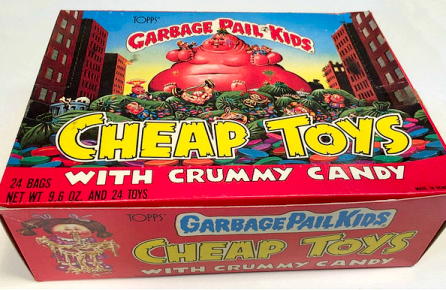
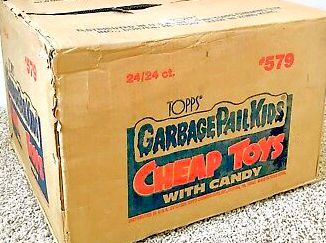
Finally,
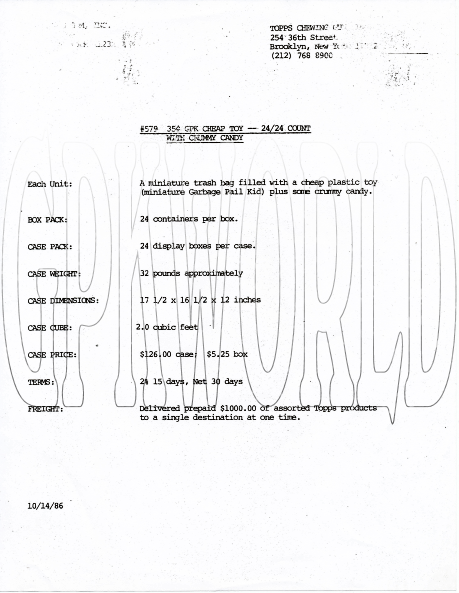
1st series Cheap Toys were sold in boxes consisting of 24 tiny dark green trash
bags each of which contained one figure, a small pack of wafers candy (Crummy
Candy) and a tiny square checklist. The units were indeed ‘cheap’ and
each cost .25 retail, also the price of a pack of Garbage Pail Kids. However many
kids noticed the toys themselves did not look like .25 vending machine toys, but
had the higher quality ‘look’ of MUSCLES figures, produced two years
prior. Cheap Toys were sold in department stores such Woolworth, and toy stores
such as Kay bee Toy Store, and gas stations such as 7-11.
Series
1 was first distributed exclusively in the United States. Some short time later
some were produced for the UK market and sent to Topps Ireland, Cork for distribution
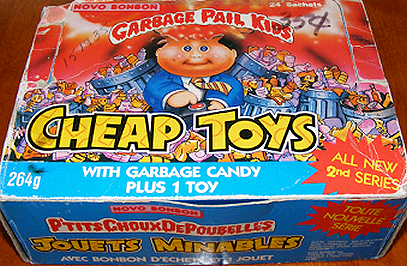
across the United Kingdom. The “UK Cheap Toy” box was modified, in keeping
with other Topps Ireland releases, with a printed white circle and the price of
a single unit on the top right hand side of the box lid. The UK Cheap Toy box
also converted the weights of its contents into grams and was printed in place
of the American measurements. Little to no variation in Cheap Toy plastics has
been proven to date. Yet a Cheap Toy color named “Midnight Blue” is
believed unique to the UK release. Another unofficial color, “Green”,
has been documented from two separate UK toy lots.
A
third, low-production run was sent to Canada for distribution that featured a
new color: Aqua, known by collectors as Canadian Aqua. A Canadian sticker, with
both French and English writing, was produced to cover the front of Cheap Toy
boxes. Canadian Aqua toys have been found in Cheap Toy boxes without this French/English
label which might suggest this as Topps late attempt to increase sales. The Cheap
Toy Base Colors printed in this Canadian run are slightly softer in both rubberiness
and color tone, but are still extremely difficult to distinguish from US ones
and collectors rely on provenance for id.
One
special difference in the Canadian Cheap Toy version is the lighter, slightly
more bluish, and more transparent garbage baggies. The transparency of Canadian
packs is so great that packs are instantly recognizable by seasoned collectors.
Another obvious advantage is that the toys are easily distinguishable without
even opening the packages. One disappoint is that the packs contain identical
printing as the US garbage baggies.
A
fourth, and final, low “test-market” run was produced in 1991 to coincide
the release of the Garbage Gang release in the UK. Since these new British Cheap
Toys were to be manufactured after the Xavier Roberts lawsuit (Post Series 9)
Topps replaced the illegal Garbage Pail Kid logo on the Cheap Toy box with the
new Garbage Gang logo. Please note that The Garbage Gang sticker included characters
from Post-Series 9 (10-13). The Garbage Gang boxes were distributed by Topps Ireland,
Cork. An unsolved mystery surrounds whether or not GG Cheap Toys were distributed
to New Zealand and Australia.
The greatest
aspect of this final release is the 4 new colors used exclusively for this Garbage
Gang release. These exclusive colors are known to collectors as UK Peach, UK Blue,
Cinnamon Red or UK Red, and UK Aqua. The plastics used in casting are much harder
than the denser, rubbery USA examples. Garbage Gang toys also float, such as in
a cup of water, which is especially helpful in sorting UK Peach and Blue from
USA Base peach and blue colors.
Some
new collectors question the large gap of time between Series 1 print runs in America,
UK, and Canada ending, probably, in 1988, to the final Garbage Gang print run
in 1991. So why did Cheap Toys disappear for 3 years? The answer lies in Topps
decision to create a second series. Thus, this decision required a completely
new set of sculpts and colors and countless artistic and marketing decisions.
Series 2 production dates are debatable, but several collectors remember purchasing
them in 1990, and one remembers 1989.
Series
2, like the first, was produced, manufactured, and distributed in Hong Kong by
the Candy Novelty Company. Theories suggest that Topps feared another lawsuit
(1987, Series 10) which lead them into producing Series 2 Cheap Toys under another
company’s name: Novo Bonbon. “Novo Bonbon” is French for Novelty
Candy! The company name “Novo Bonbon” did not exist, or at least did
not sell any products under this banner, until the CT Series 2 release. Many mysteries
surround the Novo release; although, in the grand scheme of things, this must
have been a minor detail considering the Candy Novelty Inc. were to be designing,
manufacturing, and distributing Topps Cheap Toys (and all of Topps Candy and Toy
products) anyway!
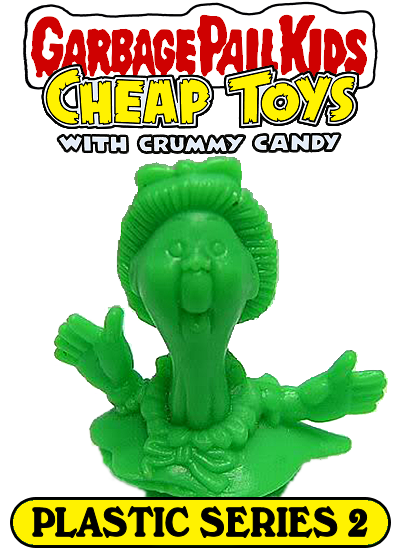
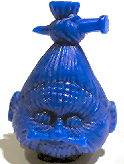
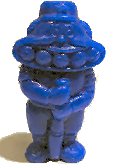
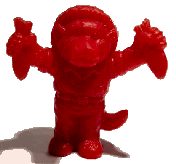
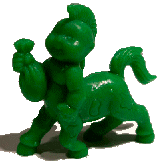
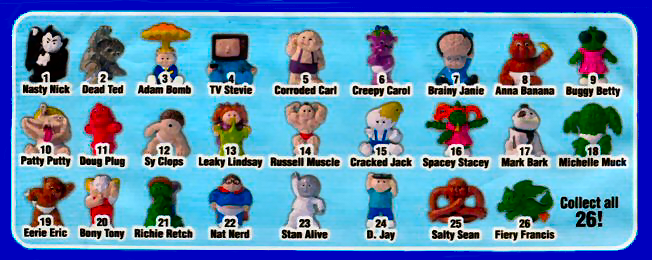
Berserk Kirk, Catty
Kathy, Les Vegas, Picky Mickey, Distorted Dot, Fishy Phyllis, Still Jill, Mouth
Phil, Ali Gator, and Galloping Glen were all transformed into mini figures for
this Series 2 release. The choice of characters still baffles many collectors,
such as Picky Mickey for example. The great, bust-style, Bony Tony was bypassed
for bust-style Mouth Phil. No Garbage Pail Kids characters from the popular first
2 sets were used, only characters from the third and fourth. On one hand, the
design team showed bravery in their decisions and as artists, such as in their
insight to create a sculpt of grim Still Jill. Series 2 is successful in part
to their electing these unlikely candidates. Another perspective is that the artists
might have wanted to take on GPK characters that could be improved upon ‘in
the round’.
The Series 2 introduced
a whole new set of 10 GPK characters in 4 colors. These sculpts were cast in 4
Base Colors: Red, Blue, Yellow, and Green (another variant green plastic exists
for this Series, a marbled Green-Blue). It is believed that Series 2 only had
one print run, which might explain why the series never progressed from the 4
original base colors. The plastic used in Series 2 is much harder than the first
series and allows the toys to float, which helps collectors id them. The 4 colors
used in Series 2 are also more brilliant with a deep saturation than those used
in USA Cheap Toys. For example, Novo Red, or Series 2 Red, is best described as
Neon Red or Electric Red, due to its high saturation and slight translucence.
Novo Yellow, or Series 2 Yellow, is exclusively and affectionately referred to
as “Sunshine Yellow” in the hobby, and best describes the color. Also,
there are 40 toys in a Series 2 Master Set. Including the Green Variant, though
only 5 examples are known, there are 50 in a Master Set. Series 2 have no copyrights
and variants within sculpts are extremely rare to nonexistent. This suggests that
Series 2 was manufactured within a short time, and in a controlled environment.
Thus, no factory errors in this release are known.
The
Novo sculpts employ a different style and must have been sculpted by a different
designer. Most collectors conclude this theory as fact. The biggest style differences
are in texture and form. Series 2 demonstrate exceptional form and the pieces
have elements that jut from all sides 3-D, such as tails and arms. The textures
used in the designs are of a different technique and different tool, such as the
bumpy nature of the character’s yarn hair. Series 2 sculpts are often praised
for their height and volume which is slightly higher than thicker than Series
1 toys.
The weaknesses of the sculpts
lie not in their composition but in ‘character’ of the characters. This
is quite the opposite critique given to Series 1 sculpts. Here, the artist seemed
to forget the spirit of the ‘kids’ he interpreted. The artist interpreted
the form but not the heart. For example, look at the expression or lack of in
Galloping Glen, and compare his spirit in the toy design to that of the original
sticker art. Several Series 2 sculpts are fully successful in form and expression,
such as the tour-de-force Distorted Dot. Humorous is how Distorted Dot is often
at the bottom of Favorite Series 2 Sculpts polls. Such is the nature and joy of
Art.
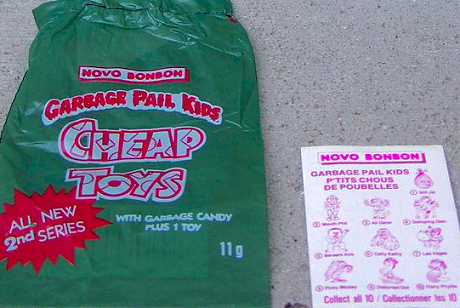
Series 2 came in similar garbage
baggies, but with new printed label. Series 2 baggies are of the bluish green
variety first introduced in the Series 1 Canadian release. Packs are also more
translucent, but not as extreme as the Series 1 Canadian packs. Each toy also
came with a newly designed, but similar, checklist featuring red line drawn characters.
Instead of Crummy Candy, Series 2 Cheap Toys came with Garbage Can-dy (another
popular Topps product, also made by the Candy Novelty Inc.) was used for this
release. This candy change was probably well received considering the overwhelming
dislike for chalkiness of Crummy Candy compared to Garbage Can-dy which has been
a kid favorite for over 4 decades now.
Perhaps,
the most interesting variation in Cheap Toys is the Series 1 sculpts cast in Series
2 plastic. Three collectors have stepped forward and remembered finding only one
or two of these per Series 2 box. A few recalled thinking it strange that the
toy could not be found on the Series 2 checklist! To this day 16 Novo Series 1
Cheap Toys have been discovered. The general term used in the toy collecting hobby
is “Super-Rares”. Novo Series 1s are GPK’s Super-Rares. The most
hopeful of the Novo discoveries is that 3 of the 16 known figures are the same
sculpt in the same color: Yellow Leaky Lindsay. The other 13 Novo S1s are completely
different. Novo S1s have been found in all 4 colors, unless counting the Green-Blue
Variant.
Compared to the other monochromatic
mini figures created before and since, and the list is enormous, GPK Cheap Toys
are held in highest regard. Many consider this mono mini toy line to be the best
ever in all the categories: sculpt, variety and choice of color, plastics, quality
of packaging and market materials, importance, and collectibility.